Malaysia semiconductor strategy: exports, execution and page analysis
Webpage checker · copperstallionmedia.com
Malaysia semiconductor strategy: exports, execution and page analysis
Visit copperstallionmedia.comRead the original long read ↗
A historical review separates export values, approved investment and industrial capability in Malaysia’s 2024 semiconductor programme.
Live HTML checked 16 October 2026 · HTTP 200 · English long read
HTML inspection
Page characteristics
Observed from the fetched public HTML. Counts cover the whole document unless labelled otherwise; article word count includes text within the first article element. These are page characteristics, not a ranking or performance score.
| HTTP status | 200 |
|---|---|
| Final response URL | https://copperstallionmedia.com/insights/ee-investment-review-2024/ |
| Title tag | Investment Review 2024: Malaysia's E&E Sector Absorbs Intel's US$7 Billion and Infineon's RM25 Billion as Exports Climb to RM491 Billion in Ten Months — Copper Stallion Media |
| Title length | 174 characters |
| Meta description | Malaysia's electrical and electronics sector closed 2024 with Intel's US$7 billion (RM31.3 billion) advanced packaging commitment in Penang and Infineon's RM25 billion fab expansion on top of RM47 billion in approved investments for January–September — 53% of all manufacturing approvals — while E&E exports rose from RM134 billion in Q1 to RM156 billion in Q3, reaching RM491 billion in January–October (+1.5%), and the National Semiconductor Strategy's RM25 billion incentives met mixed reactions over Budget 2025 allocation details. |
| Description length | 535 characters |
| HTML language | en |
| Canonical URL | https://copperstallionmedia.com/insights/ee-investment-review-2024/ |
| Meta robots | index,follow |
| Viewport | width=device-width, initial-scale=1.0 |
| Heading counts | H1: 1 · H2: 11 · H3: 8 · H4: 0 · H5: 0 · H6: 0 |
| H1 text | Investment Review 2024: Malaysia's E&E Sector Absorbs Intel's US$7 Billion and Infineon's RM25 Billion as Exports Climb to RM491 Billion in Ten Months |
| Article element word count | 2,637 words |
| Whole-page image elements | 21 |
| Images with non-empty alt text | 21 |
| Whole-page links | 49 |
| External link elements | 14 |
| Response HTML size | 37,209 bytes (UTF-8 snapshot) |
Article overview
Malaysia’s semiconductor ambitions require several kinds of evidence to be read on their own terms. Copper Stallion Media’s year-end 2024 review brings together electrical and electronics exports, investment commitments, policy support and the capability needed to convert plans into production. Its organizing contrast is between volatile technology share prices and a steadier export sequence. Those observations concern different parts of the economy: a market valuation can change without directly measuring factory output, while export values do not describe the return earned by every listed company.
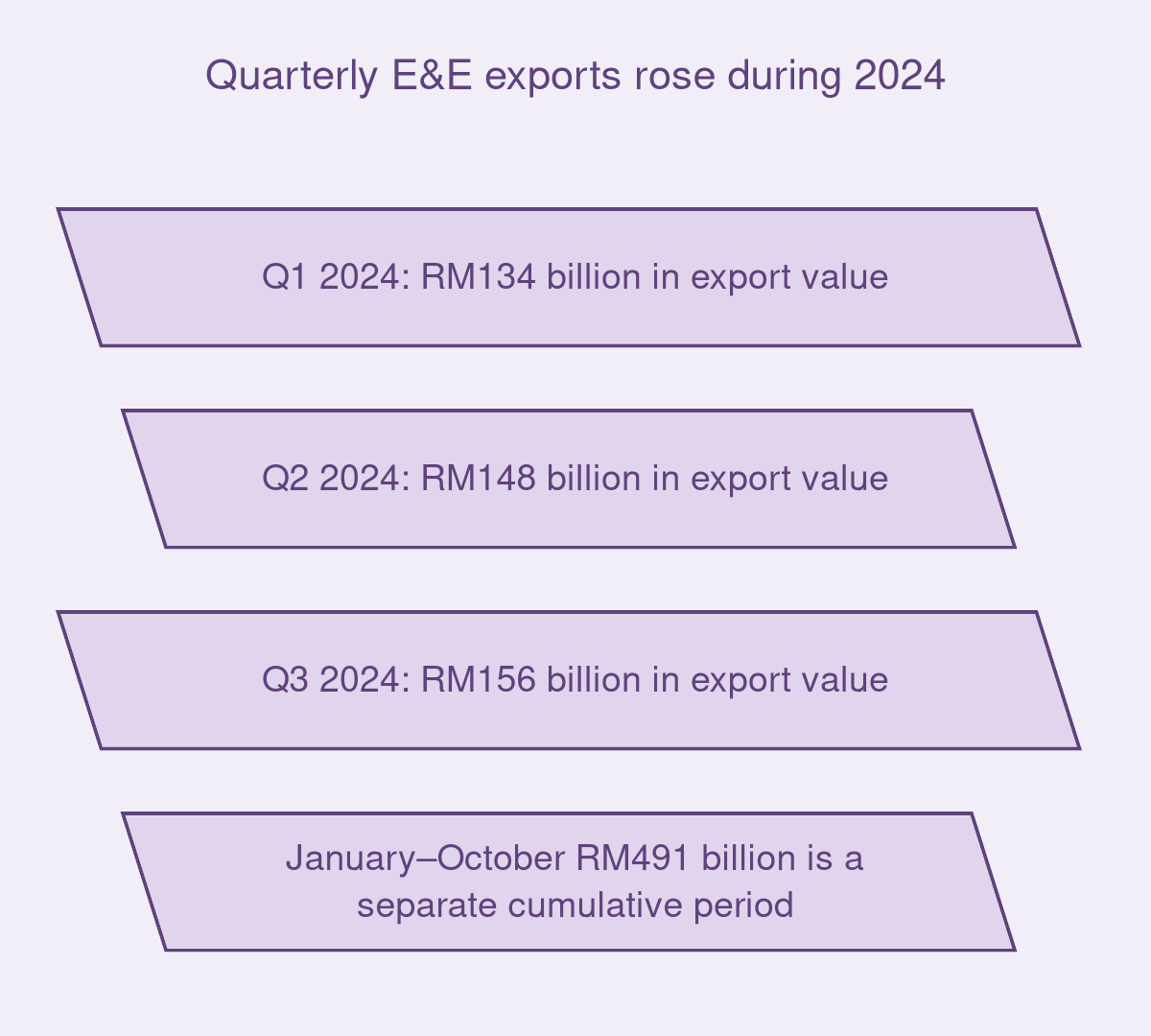
The article reports E&E exports of RM134 billion in the first quarter of 2024, RM148 billion in the second and RM156 billion in the third. It separately gives RM491 billion for January through October, up 1.5 percent against the corresponding prior-year period. The ten-month cumulative figure is not another quarter and should not be appended to the quarterly sequence as though it had the same duration. These are monetary export values, so the pattern alone does not establish growth in physical shipment volumes. The source uses them to explain why an industry representative described the sector as expanding consistently.
Investment announcements add a forward-looking layer. The review discusses Intel’s reported US$7 billion advanced packaging commitment and Infineon’s RM25 billion fabrication expansion, alongside wider digital infrastructure plans. It also reports RM47 billion of approved E&E investments during January–September 2024, representing 53 percent of manufacturing approvals. Commitments and approvals point to a pipeline; they do not by themselves establish completed facilities, operating capacity or future exports. Currency, period and status need to stay attached to each amount rather than being combined into a single measure of money already spent.
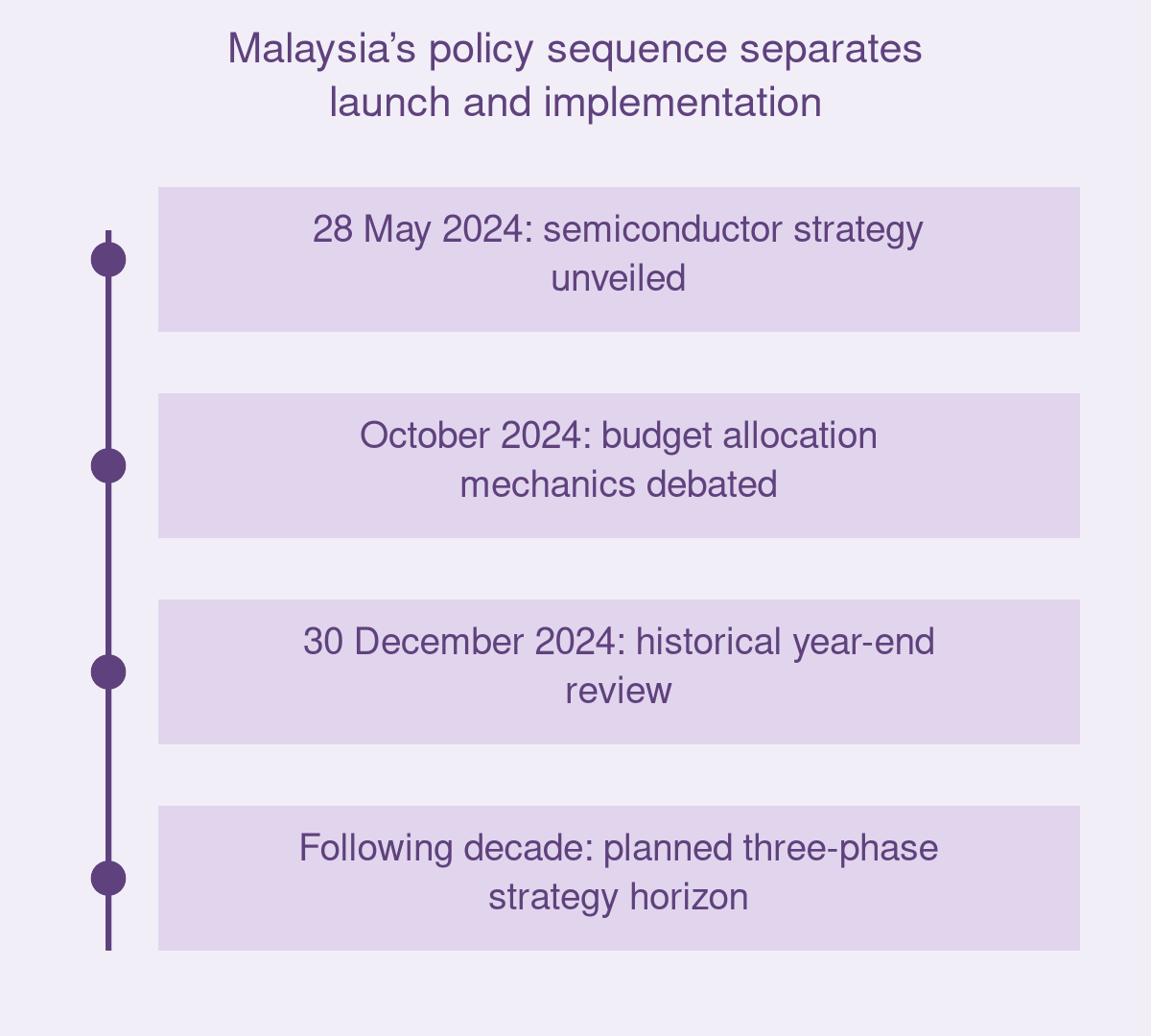
The National Semiconductor Strategy supplies the policy framework. The source dates its unveiling to 28 May 2024 and describes a three-phase programme over the following decade, with RM25 billion in targeted incentives. Its account of October budget reactions concerns uncertainty over allocation and implementation, not simply the headline sum. Industry views quoted in the review emphasize movement into design, fabrication and advanced packaging while warning against following one fashionable technology at the expense of lasting capability. The historical policy discussion remains distinct from proof that all programme targets were achieved.
Talent, research and execution connect the financial announcements with practical industrial development. The article identifies engineering skills, industry–university links and R&D as constraints alongside infrastructure and international competition. Its longer-term market growth figures are projections, not observed results for 2029. Read together, the material offers a useful way to review an industrial strategy: distinguish traded values from equity prices, intentions from operating assets, and available incentives from implemented capability. Subsequent evidence would need to show whether the announced resources produced suitable facilities, skilled teams and sustained activity rather than assuming that one large investment figure answers every question.


Comments
Post a Comment