Clean samples and batch coverage: inspection and page analysis
Webpage checker · market-for-profits.com
Clean samples and batch coverage: inspection and page analysis
Visit market-for-profits.comRead the original long read ↗
A constructed fixed-batch exercise separates accurate testing from the chance of encountering a failure.
Live HTML checked 16 October 2026 · HTTP 200 · English long read
HTML inspection
Page characteristics
Observed from the fetched public HTML. Counts cover the whole document unless labelled otherwise; article word count includes text within the first article element. These are page characteristics, not a ranking or performance score.
| HTTP status | 200 |
|---|---|
| Final response URL | https://market-for-profits.com/articles/batch-sampling-missed-defect-risk-2025/ |
| Title tag | A Clean Sample Does Not Clear Every Item | Market for Profits |
| Title length | 61 characters |
| Meta description | A fictional twenty-item batch explains how random sampling can miss existing defects and why detection probability is not a verdict on every untested item. |
| Description length | 155 characters |
| HTML language | en |
| Canonical URL | https://market-for-profits.com/articles/batch-sampling-missed-defect-risk-2025/ |
| Meta robots | index,follow |
| Viewport | width=device-width,initial-scale=1 |
| Heading counts | H1: 1 · H2: 11 · H3: 7 · H4: 0 · H5: 0 · H6: 0 |
| H1 text | A Clean Sample Does Not Clear Every Item |
| Article element word count | 2,138 words |
| Whole-page image elements | 23 |
| Images with non-empty alt text | 23 |
| Whole-page links | 37 |
| External link elements | 14 |
| Response HTML size | 27,811 bytes (UTF-8 snapshot) |

Article overview
A clean inspection result can accurately describe a sample while leaving failures elsewhere in the delivery. Market for Profits explains this distinction through a fixed-batch probability exercise. A discussion of a honey-market charter provides the opening context, but the example does not reproduce that programme’s testing rules or estimate defects in actual products. Its narrow subject is the chance that a specified selection process encounters a failure already stipulated to exist.
The constructed batch contains twenty distinct sealed items, exactly two of which fail an invented binary specification. A perfect test is assumed, so a selected failing item is always detected. Items are sampled uniformly without replacement, giving every subset of the chosen size the same probability. These are model assumptions, not findings from a real receiving process. They separate selection coverage from laboratory accuracy: the test can work perfectly while the sample misses the items that matter.
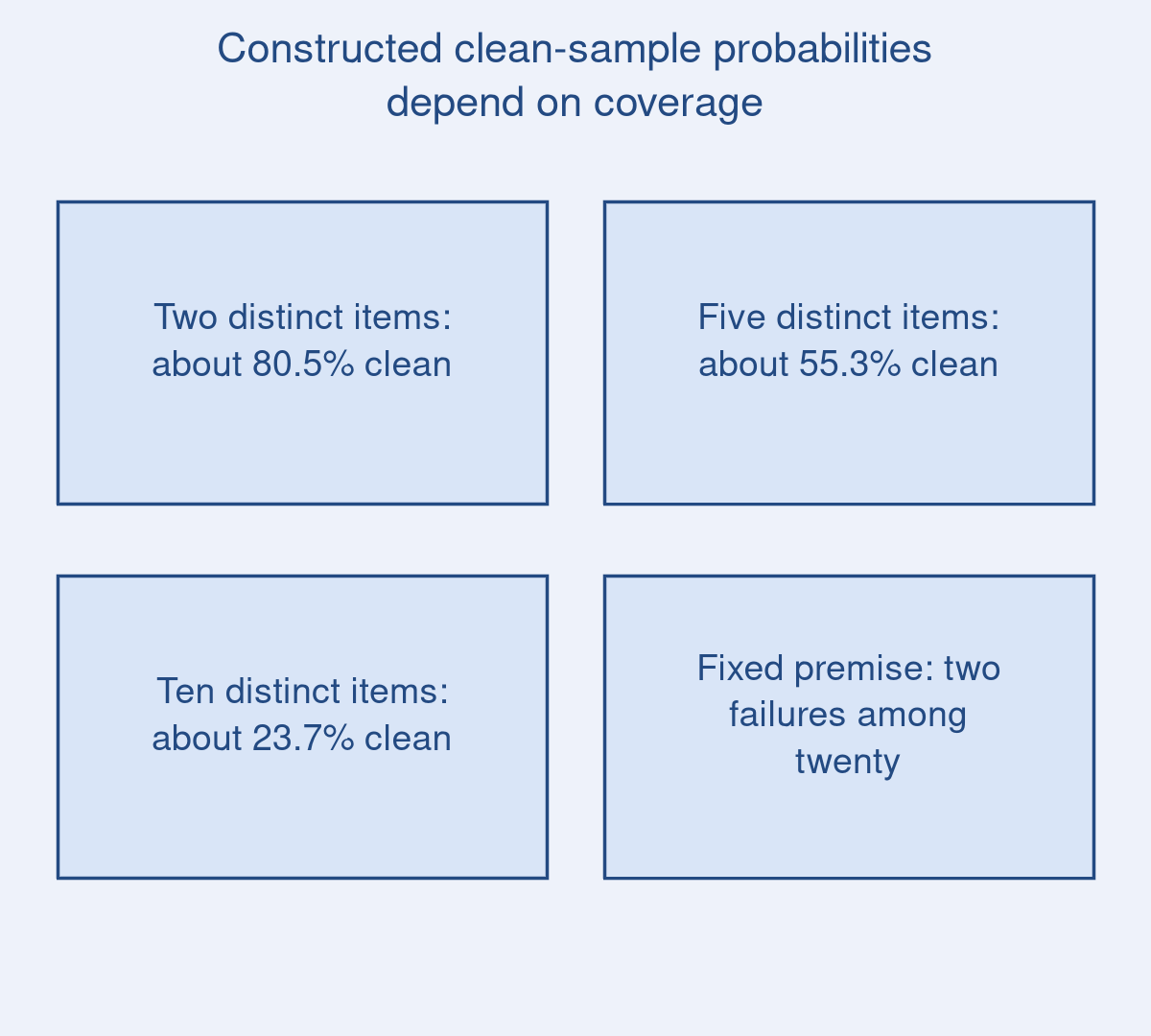
For two selected items, the probability of both being conforming is eighteen twentieths multiplied by seventeen nineteenths, approximately 80.5%. Detecting at least one failure therefore has probability about 19.5%. Increasing the sample to five lowers the no-detection probability to approximately 55.3%; ten reduces it to about 23.7%. All percentages are conditional on the same invented batch composition and selection rule. They do not establish a required sample size, an acceptable safety threshold or an actual company’s performance.
The conditional direction is central. The probability of a clean sample given a defective batch is different from the probability that an unknown batch is clean after observing a sample. The latter would require another model of possible batch conditions and prior information. Within this exercise, two failures remain present by definition. Testing the same conforming item repeatedly also does not create the coverage obtained by selecting additional distinct items. A count of test runs can therefore conceal the population actually examined.
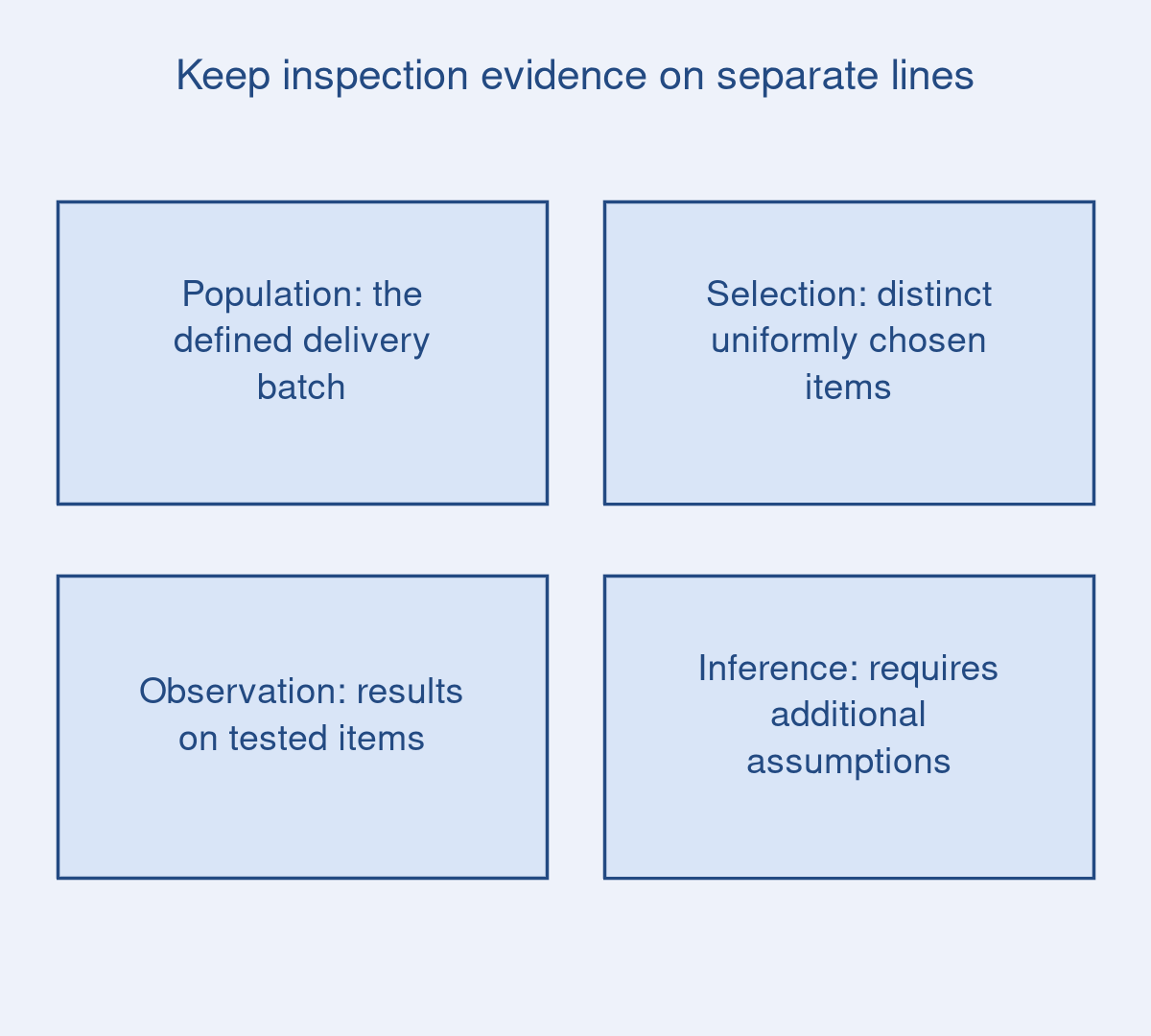
The final sections stress that convenience selection or a changing batch would require different assumptions. Choosing accessible packages is not automatically equivalent to a uniform random sample, and a test covering one property does not establish all other product characteristics. The article’s contribution is a precise reporting discipline: identify the population, describe selection, record what was found and keep a conditional design calculation separate from a broader receiving decision. A clean observation remains useful when its limits are stated, rather than being enlarged into an unsupported assurance about every untested item.


Comments
Post a Comment