Cold-climate heat pumps: testing, launches and page analysis
Webpage checker · trueindustrynews.com
Cold-climate heat pumps: testing, launches and page analysis
Visit trueindustrynews.comRead the original long read ↗
Separating laboratory measurements, occupied-home trials and manufacturing milestones.
Live HTML checked 16 October 2026 · HTTP 200 · English long read
HTML inspection
Page characteristics
Observed from the fetched public HTML. Counts cover the whole document unless labelled otherwise; article word count includes text within the first article element. These are page characteristics, not a ranking or performance score.
| HTTP status | 200 |
|---|---|
| Final response URL | https://trueindustrynews.com/intelligence/cold-climate-heat-pumps-testing-production-2024/ |
| Title tag | Cold-climate heat pumps move from field trials to production · True Industry News |
| Title length | 81 characters |
| Meta description | Cold-climate heat pump trials connect laboratory performance, product launches and plant plans, with separate milestones for homes and commercial rooftop units. |
| Description length | 160 characters |
| HTML language | en |
| Canonical URL | https://trueindustrynews.com/intelligence/cold-climate-heat-pumps-testing-production-2024/ |
| Meta robots | index,follow |
| Viewport | width=device-width,initial-scale=1 |
| Heading counts | H1: 1 · H2: 8 · H3: 15 · H4: 0 · H5: 0 · H6: 0 |
| H1 text | Cold-climate heat pumps move from field trials to production |
| Article element word count | 2,326 words |
| Whole-page image elements | 29 |
| Images with non-empty alt text | 29 |
| Whole-page links | 41 |
| External link elements | 16 |
| Response HTML size | 34,153 bytes (UTF-8 snapshot) |
Article overview
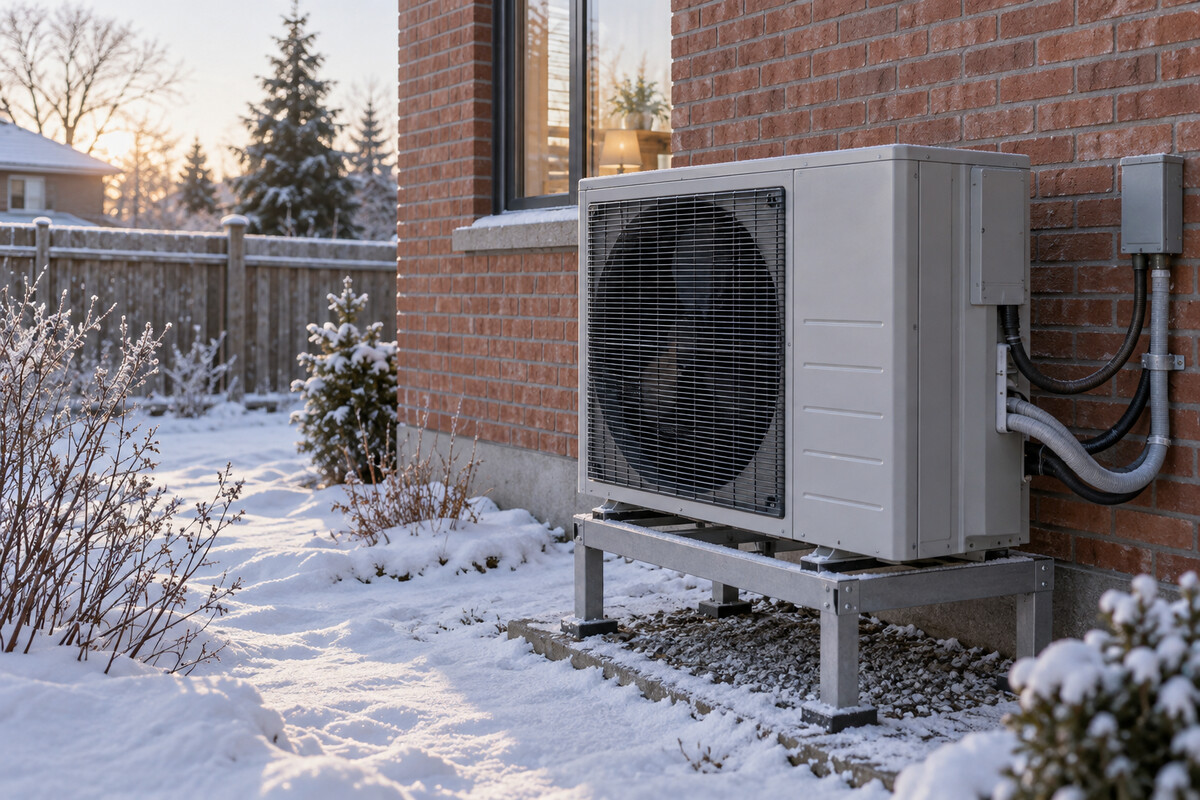
The transition from a successful cold-weather prototype to an available heating product involves several different milestones. True Industry News traces that progression through the Department of Energy’s residential heat-pump challenge and manufacturers’ subsequent announcements. Eight participants had completed field testing by the October 23, 2024 announcement. Trials covered 23 sites across ten American states and two Canadian provinces. These figures describe the programme’s reach; they do not establish identical performance for every manufacturer, model or installation. The article keeps the residential challenge separate from the development programme for commercial rooftop equipment.
Laboratory results provide controlled comparisons with defined limits. An Oak Ridge investigation of a nominal three-ton Rheem system recorded an adjusted HSPF2 of 9.4 against an adjusted minimum of 8.5. Its commercialisation assessment concerned one sample. Regulatory testing, cold-climate operation with the specified supplementary heater, and demand-response testing used different operating arrangements. Johnson Controls likewise separated completed laboratory work from three planned field installations. Its approximately 200,000-unit prospective annual manufacturing capacity belonged to a separate factory initiative, rather than output from those prototype sites.
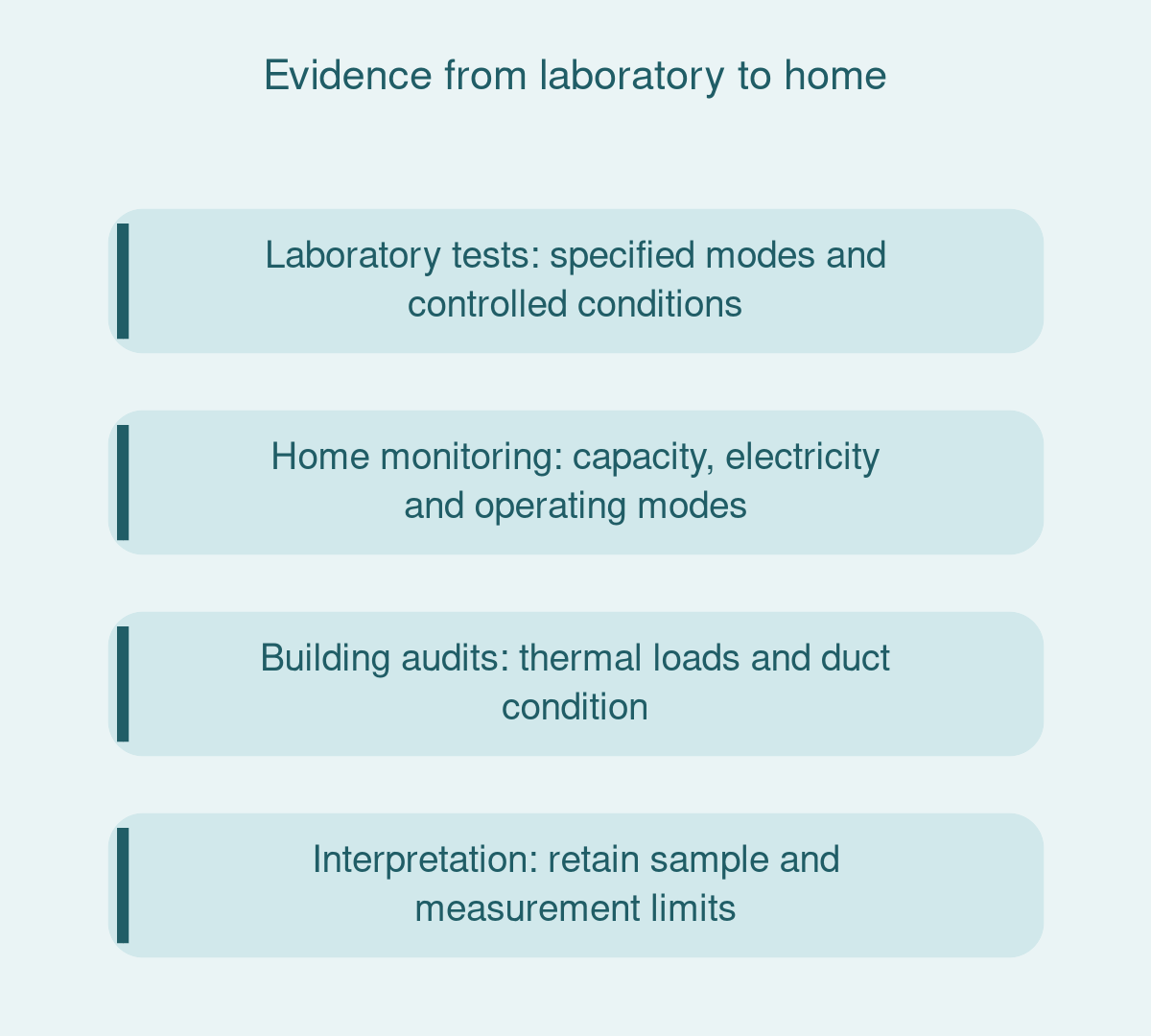
Occupied-home studies add the building and its distribution system to the assessment. The source describes a separate National Renewable Energy Laboratory project that recorded airside and electricity measurements every five seconds. Researchers combined those records with thermal assessments and duct audits, distinguishing defrost, supplementary heat and other operating modes. Another experiment examined two Bosch systems under different airflow and pressure conditions. Its measured capacity differences at elevation applied to those systems and methods. The study did not calculate annual performance, distribution losses or cost effectiveness, so the results cannot supply those missing outcomes.
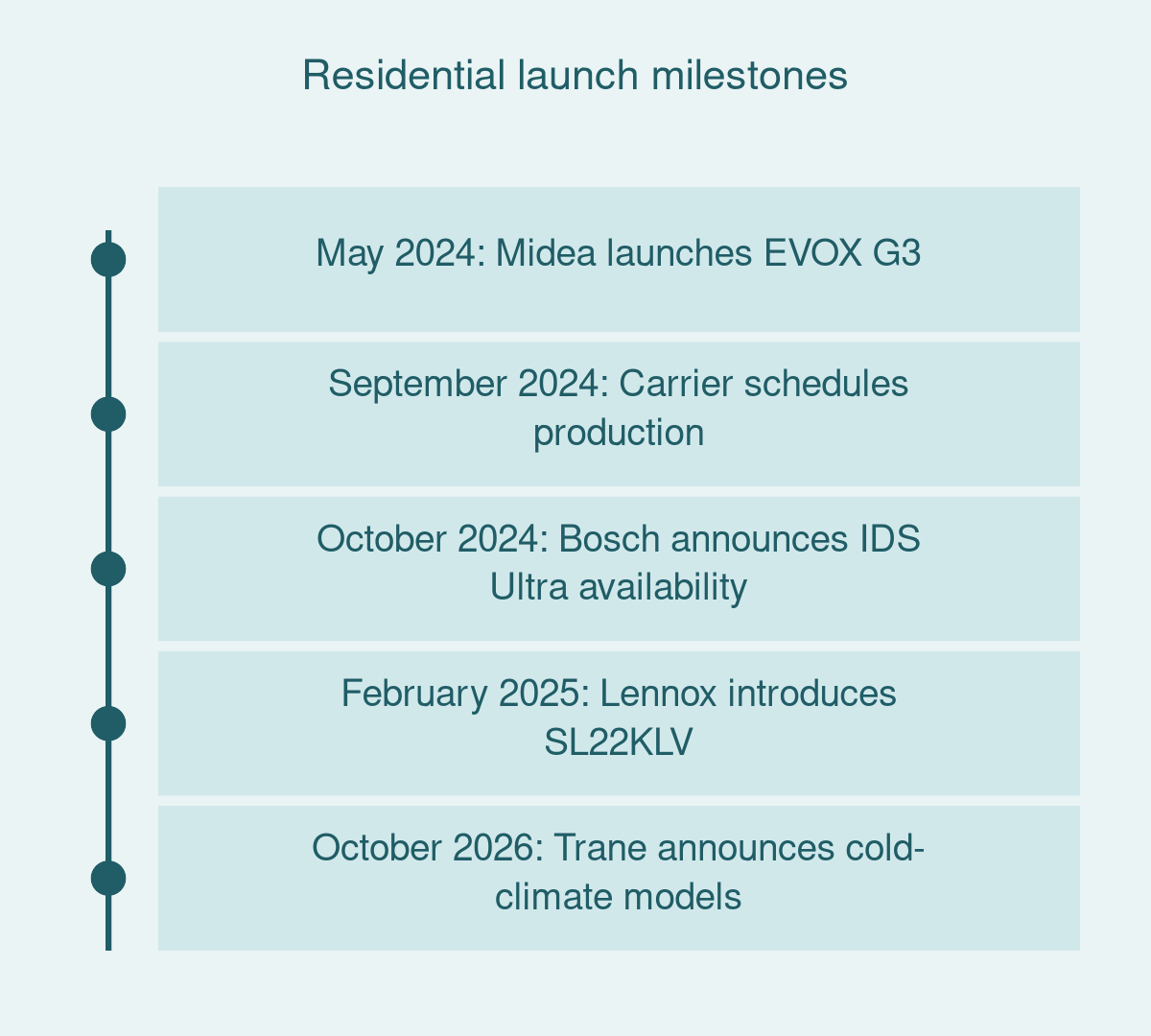
Product announcements then introduce their own dates and temperature conditions. Carrier scheduled production in September 2024 after residential trials, distinguishing field operation down to −13°F from laboratory operation down to −23°F. Bosch announced professional availability of IDS Ultra the following month, specifying full heating capacity at 5°F. Midea’s May launch combined an outdoor unit with a modular air handler, while discussing a forthcoming challenge prototype separately. Lennox’s February 2025 launch and Trane’s October 2026 announcement extended the chronology. A low operating temperature alone does not state capacity or efficiency at that temperature.
Commercial development and factory support remain separate evidence streams. DOE’s April 2024 rooftop accelerator aimed for market availability as early as 2027; projected utility savings were programme potential, not measured savings in residential trial homes. August factory selections required negotiations and environmental review before funding. Their proposed output combined several equipment categories and therefore cannot be treated as a single count of completed cold-climate heat pumps. Read together, the source’s testing records, availability notices and conditional manufacturing plans describe successive steps, each with a different population, measurement boundary and level of completion.


Comments
Post a Comment