Cleaning shifts: access, scope and page analysis
Webpage checker · stateandlocal.org
Cleaning shifts: access, scope and page analysis
Visit stateandlocal.orgRead the original long read ↗
Connecting room availability, preparation, task time and handover before repeating a short visit.
Live HTML checked 16 October 2026 · HTTP 200 · English long read
HTML inspection
Page characteristics
Observed from the fetched public HTML. Counts cover the whole document unless labelled otherwise; article word count includes text within the first article element. These are page characteristics, not a ranking or performance score.
| HTTP status | 200 |
|---|---|
| Final response URL | https://stateandlocal.org/briefings/cleaning-shift-capacity-local-services-2026/ |
| Title tag | Cleaning Shifts That Fit the Working Day | State & Local |
| Title length | 56 characters |
| Meta description | Short cleaning visits depend on access, a clear work list and a useful handover. A worked scheduling example shows how two site timetables can conflict. |
| Description length | 152 characters |
| HTML language | en |
| Canonical URL | https://stateandlocal.org/briefings/cleaning-shift-capacity-local-services-2026/ |
| Meta robots | Not declared |
| Viewport | width=device-width,initial-scale=1 |
| Heading counts | H1: 1 · H2: 13 · H3: 8 · H4: 0 · H5: 0 · H6: 0 |
| H1 text | Cleaning Shifts That Fit the Working Day |
| Article element word count | 2,479 words |
| Whole-page image elements | 23 |
| Images with non-empty alt text | 23 |
| Whole-page links | 38 |
| External link elements | 14 |
| Response HTML size | 30,461 bytes (UTF-8 snapshot) |

Article overview
A short cleaning visit depends on the fit between a worker’s attendance and the premises’ actual availability. State and Local develops this point from June reporting on business interest in temporary cleaning staff, citing Avito research through Kommersant. The source’s focus is routine commercial service organisation rather than specialist cleaning methods. A calendar booking alone cannot establish that rooms, supplies and the receiving contact will be ready. The useful planning unit is an agreed visit with a place, time window, scope and handover that can work together.
The article begins with room-level availability rather than general opening hours. A closed shop may still contain working staff, and a quiet receiving area may become busy just as the visit starts. Arrival therefore needs separation from access to the first agreed task. A concise scope should identify included areas, recurring work, additions and exclusions. The person accepting changes also needs to be known. Otherwise an extra request can displace the original priorities without an explicit agreement about what will remain unfinished.
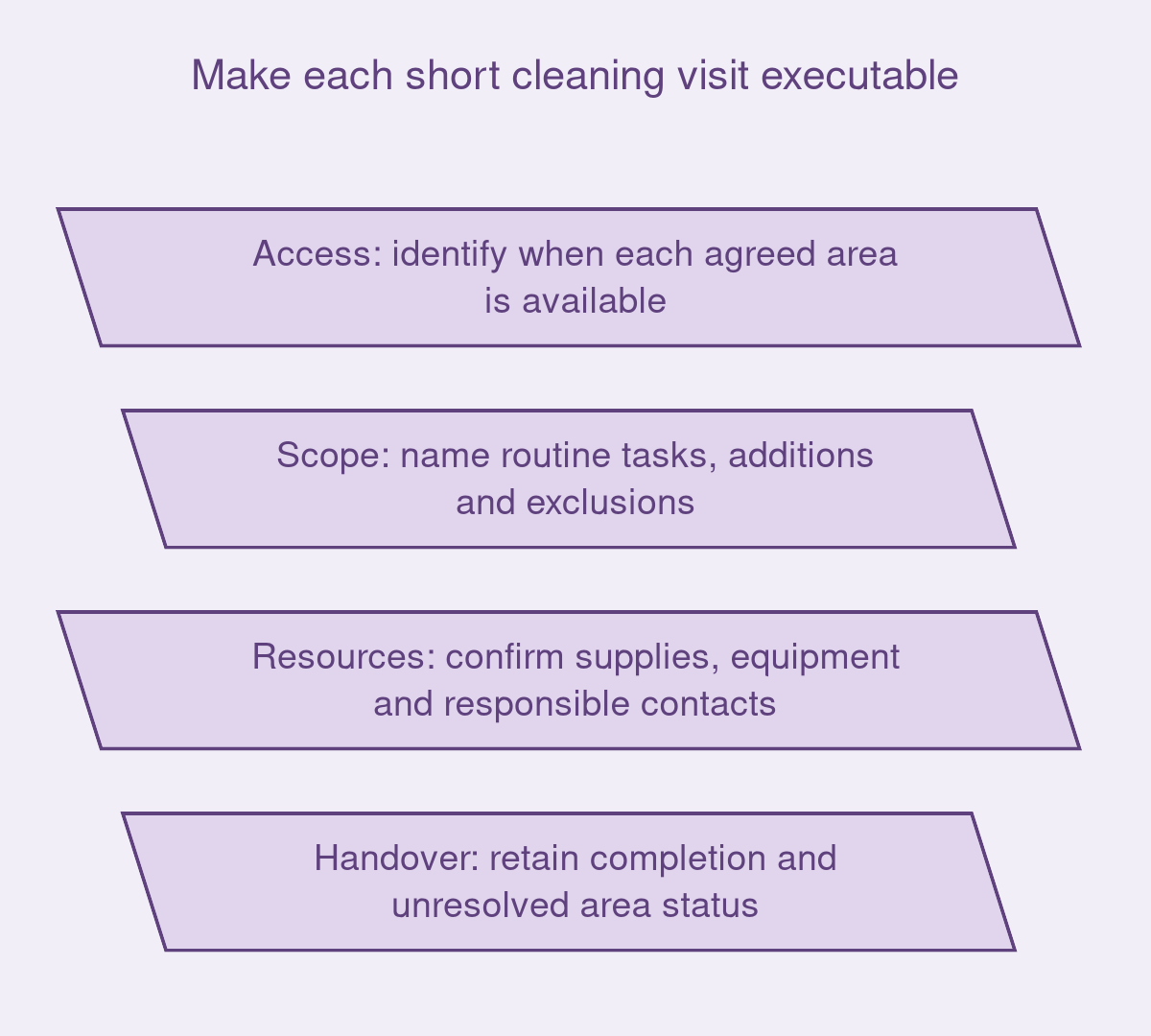
A reusable site brief preserves these arrangements when either contact or worker changes. The source proposes a responsible person and backup, access windows, resource responsibilities and a completion recipient, with sensitive entry information kept outside broadly shared schedules. Preparation, movement and handover belong in the sequence alongside task time. Its hypothetical two-site example makes this visible: Site A takes 80 minutes from an 18:00 start, followed by 15 minutes of travel and a 60-minute Site B visit. The resulting 20:35 finish exceeds Site B’s 20:15 handback by 20 minutes. These durations are invented planning inputs, not measured cleaning rates.
The example also explains why unused margin after Site A’s planned departure cannot be removed from its tasks to solve the conflict. A real change is needed in access, agreed scope or staffing, rather than an unsupported promise to do identical work faster. During a visit, an occupied room, extra task and missing supplies should retain different descriptions because they call for different responses. An inaccessible area should remain an exception rather than be marked complete. The handover should identify finished areas, outstanding conditions and any follow-up already agreed.
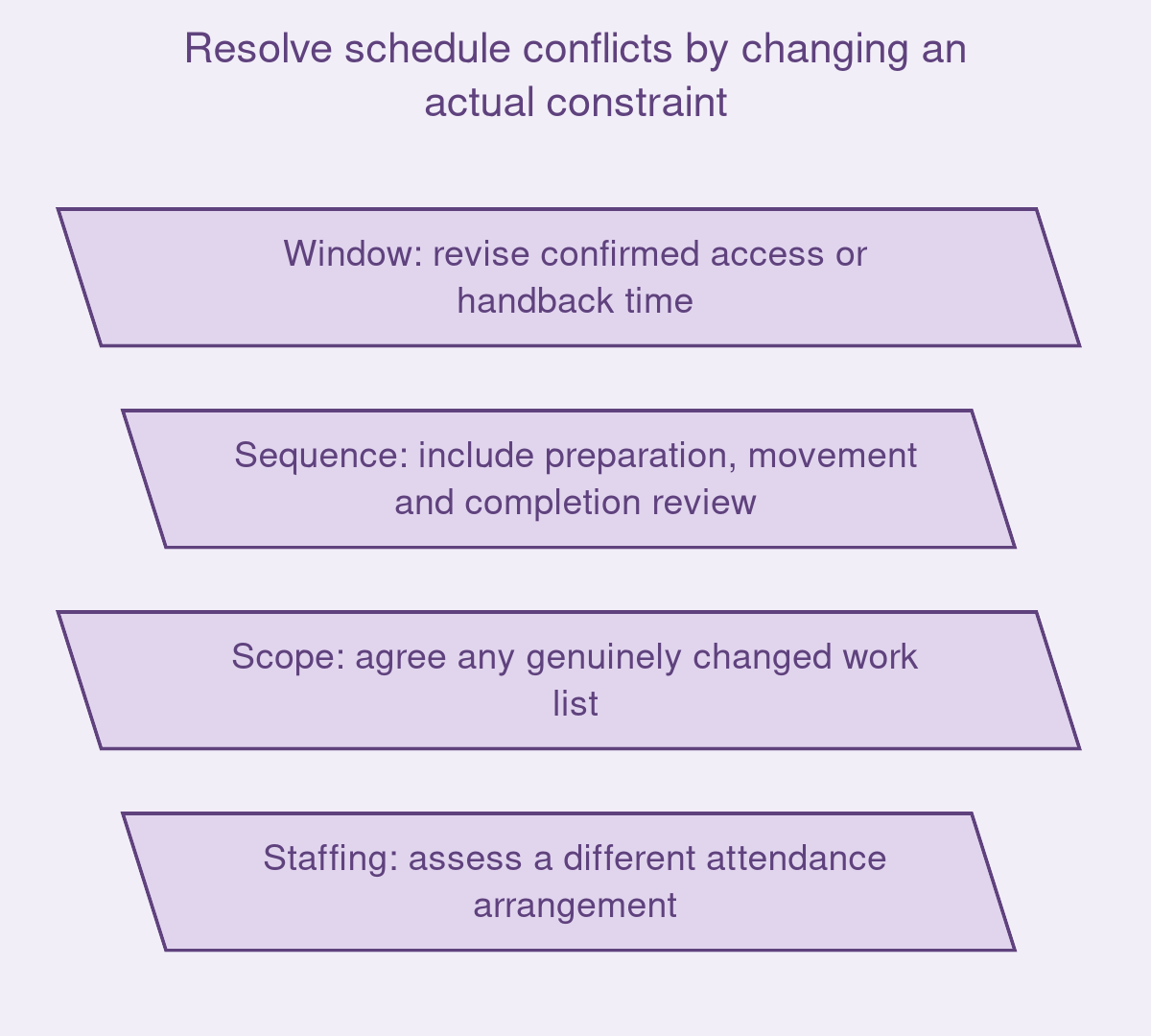
Recurring reviews become useful when scope and circumstances remain comparable. A post-event visit differs from ordinary service, and a one-off blocked entrance should not automatically become a permanent allowance. The first visit can test selected assumptions about access, instructions or handover and produce specific amendments with owners. Those changes should be confirmed before becoming a recurring timetable. The article’s contribution is a practical distinction between a convenient appointment and an executable service agreement. Its recommendations keep responsibility visible and unresolved conditions recoverable without turning one illustrative schedule into a universal staffing standard.


Comments
Post a Comment