Egg-market stabilization: supply, prices and page analysis
Webpage checker · newspectrum.org
Egg-market stabilization: supply, prices and page analysis
Visit newspectrum.orgRead the original long read ↗
An early-2024 account separates retail price easing, lower output, import capacity and the timetable for domestic recovery.
Live HTML checked 16 October 2026 · HTTP 200 · English long read
HTML inspection
Page characteristics
Observed from the fetched public HTML. Counts cover the whole document unless labelled otherwise; article word count includes text within the first article element. These are page characteristics, not a ranking or performance score.
| HTTP status | 200 |
|---|---|
| Final response URL | https://newspectrum.org/features/ns-2024-feat-04-russia-egg-market-recovery/ |
| Title tag | Russia's Egg Market After the Price Shock: Six Months of Falling Output and a Stabilization Nobody Could Rush — newspectrum.org |
| Title length | 127 characters |
| Meta description | Egg output fell 1.8% in Jan-Feb 2024 after a 1.6-fold price rise in 2023; duty-free imports, contracts and 15-year loans framed a slow recovery. |
| Description length | 144 characters |
| HTML language | en |
| Canonical URL | https://newspectrum.org/features/ns-2024-feat-04-russia-egg-market-recovery/ |
| Meta robots | index, follow |
| Viewport | width=device-width, initial-scale=1 |
| Heading counts | H1: 1 · H2: 16 · H3: 7 · H4: 3 · H5: 0 · H6: 0 |
| H1 text | Russia's Egg Market After the Price Shock: Six Months of Falling Output and a Stabilization Nobody Could Rush |
| Article element word count | 2,203 words |
| Whole-page image elements | 23 |
| Images with non-empty alt text | 23 |
| Whole-page links | 45 |
| External link elements | 13 |
| Response HTML size | 31,070 bytes (UTF-8 snapshot) |
Article overview
An easing retail price does not necessarily mean production has recovered after a food-market shock. Newspectrum examines that distinction through Russia’s egg market in early 2024. The source connects the preceding year’s price rise with lower output, import measures, contracts and the time required to restore affected flocks. Its observations belong to the winter and spring reporting period. They do not establish the market’s subsequent condition or prove that every proposed response produced its intended effect.
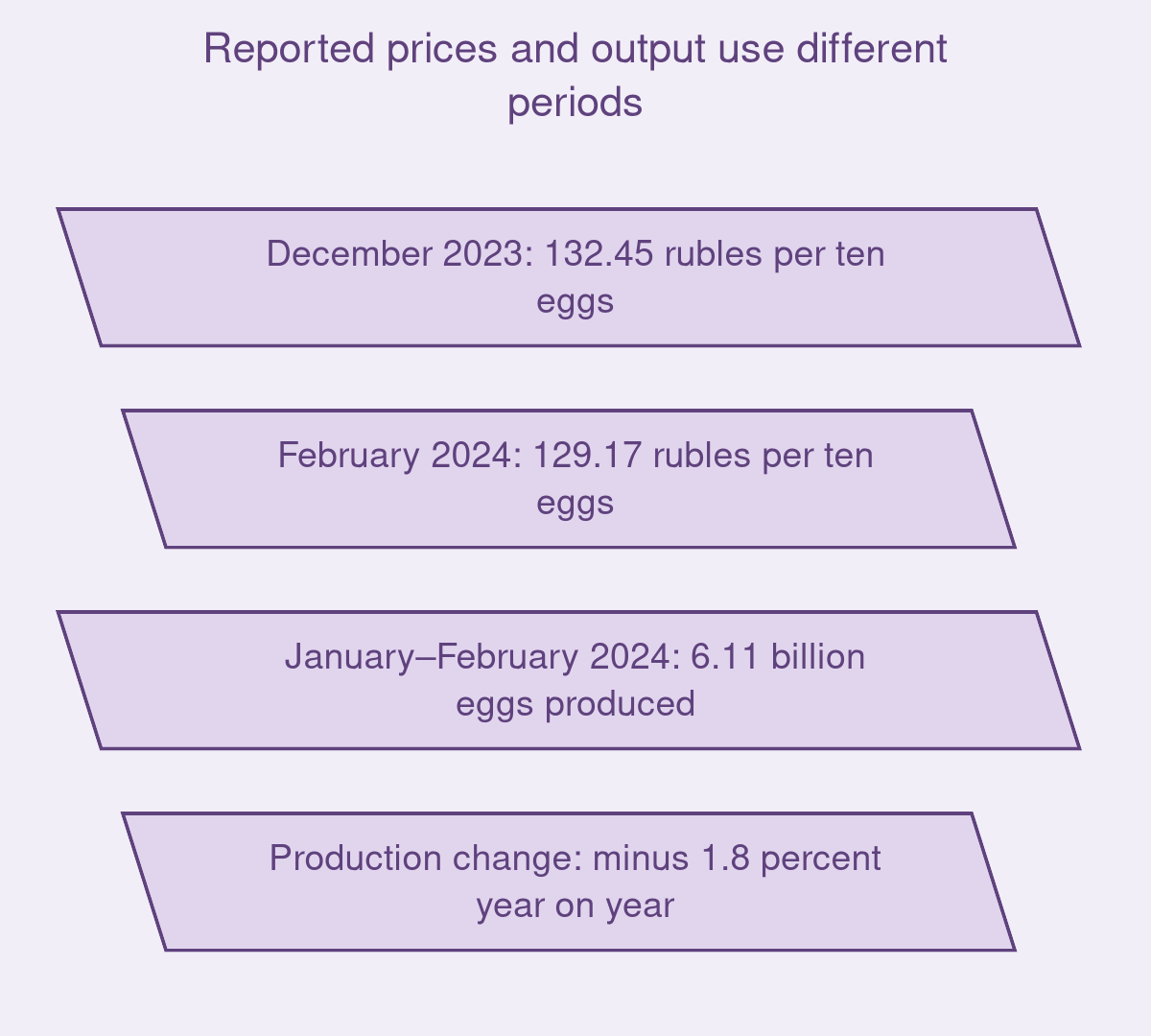
The article reports a December 2023 retail average of 132.45 rubles per ten eggs after prices rose roughly 1.6 times during the year. It gives a lower February 2024 average of 129.17 rubles for the same unit. That comparison describes a modest retreat from a high level, not a return to the earlier price base. Separately, the source reports January–February output of 6.11 billion eggs, down 1.8 percent year on year. A two-month production total, a monthly retail average and a full-year growth comparison answer different questions and should retain their periods.
The supply explanation cites industry participants linking disruption with avian influenza and describing recovery at affected farms as potentially taking months. Those comments concern operational rebuilding, while national poultry headcounts and meat output cover broader populations than laying flocks alone. Their divergence helps frame questions but does not independently isolate every cause of lower egg production. Regional restoration and expansion expectations also remain forecasts until later output confirms them. The useful point is that recovery of a productive flock follows its own timetable rather than the reporting cycle of a price release.
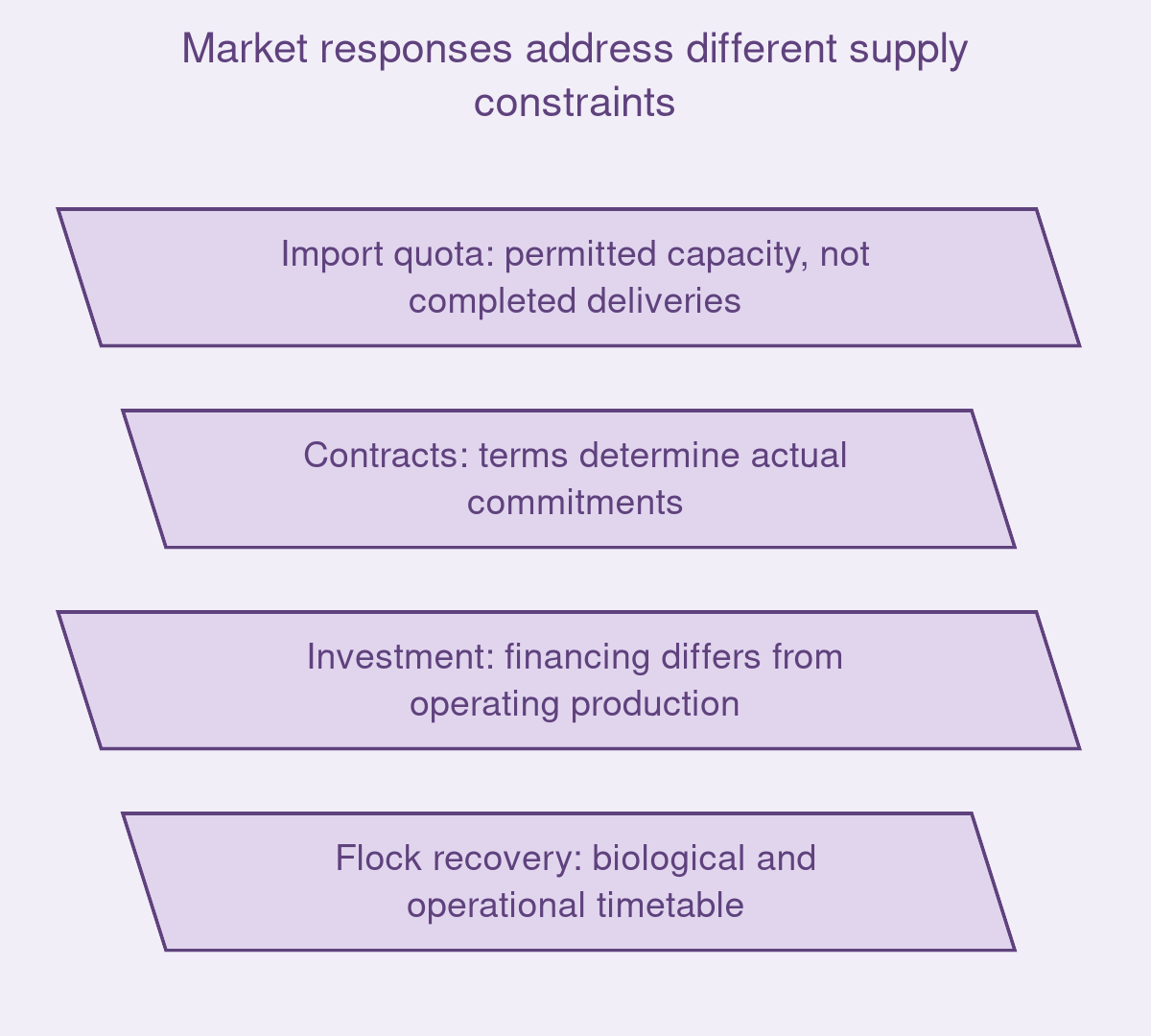
Policy measures operate through different channels. The article describes a duty-free import quota of 1.2 billion eggs for 2024, price-restraint arrangements, efforts toward longer-term contracts and extended lending terms for construction. A quota is permitted capacity, not evidence that the entire amount arrived or reached retail shelves. Imported egg products used by food manufacturers are also distinct from table eggs bought by households. Contracts may improve visibility, but their actual provisions determine commitments. A longer borrowing horizon cannot alone guarantee an investment’s viability or shorten the biological process of rebuilding supply.
The source reports retailers describing adequate availability while participants awaited seasonal demand around Easter. Those accounts provide evidence from particular observers, not a complete balance sheet proving why prices stabilized. Later comparable information on output, imports, prices and deliveries would be needed to assess the combined response. The article’s practical contribution is to distinguish immediate supply flexibility from slower domestic recovery. Reading the measures together is useful when each keeps its own unit, coverage and status, leaving uncertainty visible rather than converting an announced quota or expected recovery into a completed result.


Comments
Post a Comment